

The Salmon House Across the Bay: Fishing in The Parishes of Assynt and Eddrachillis
From herring shoals in Loch Glendhu to lobster boats bound for London, discover the changing history of fishing around Badcall Bay, Kylestrome and Lochinver.
From Eddrachilles Hotel, the old salmon house across Badcall Bay is an easy landmark to pick out. Its story opens onto a much wider history: herring shoals and fishing stations, nets mended ashore, and boats carrying live lobsters south to London.
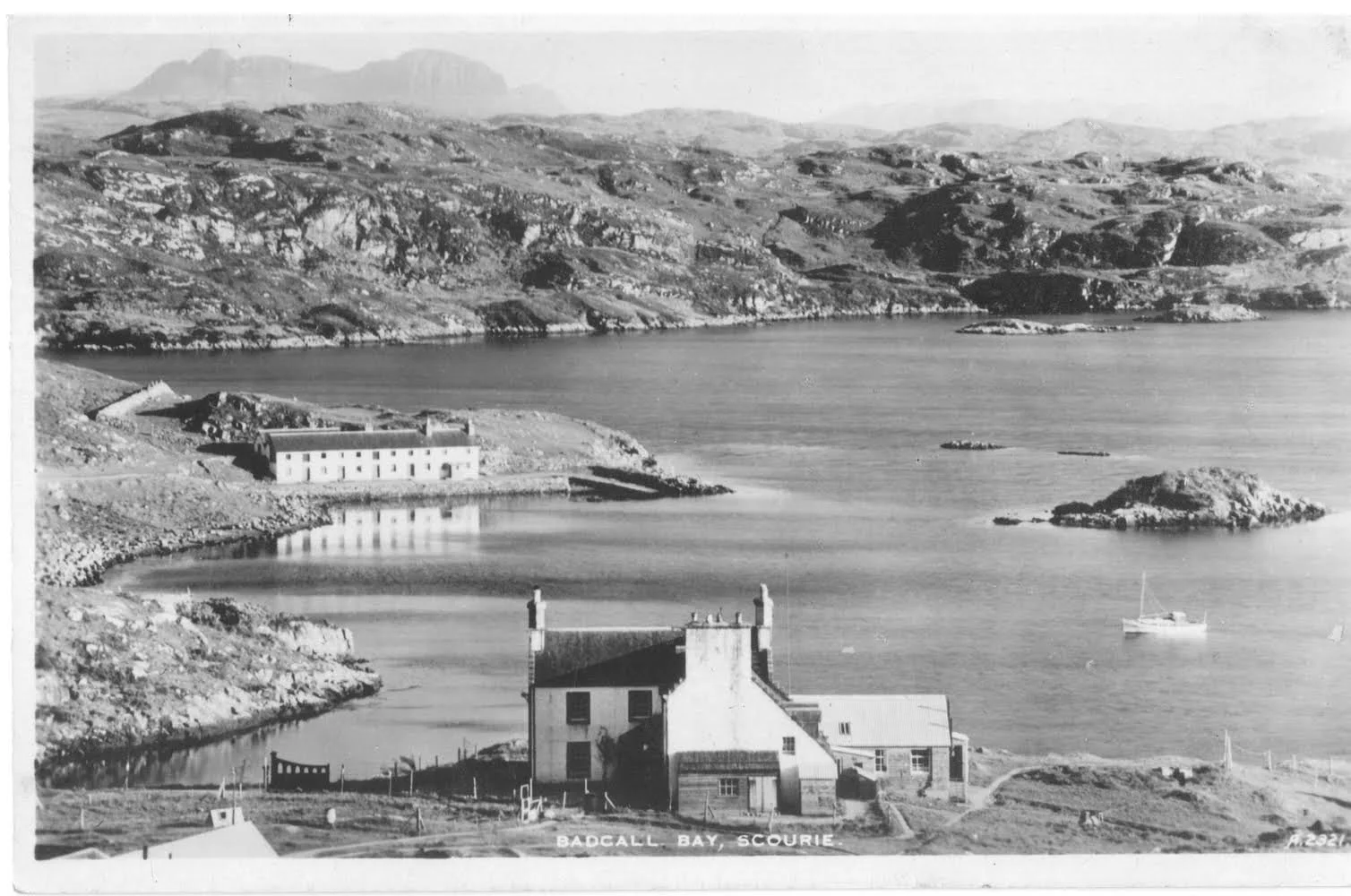
Old Postcard. the Salmon house by the pier, the former manse, now Eddrachilles Hotel, in the foreground. The drop to the shore from the front of the hotel is evident.
Look across Badcall Bay from Eddrachilles Hotel and the salmon house catches the eye. The hotel stands in the former parish manse; across the water, the old salmon house is now the mainland headquarters of Loch Duart, a salmon fish farm.
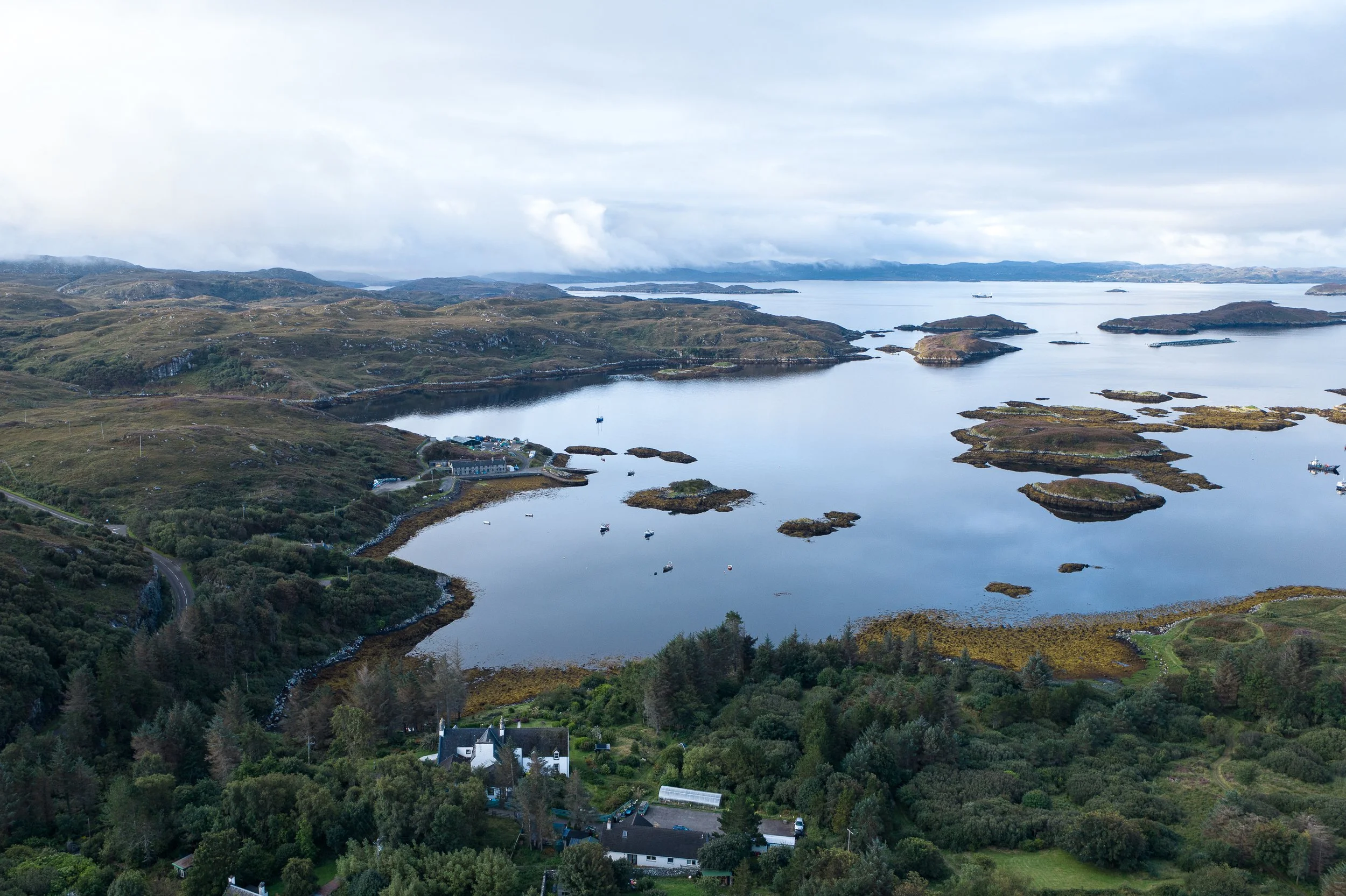
The buildings invite a question: what has fishing meant to this coast? The answer is not one simple story of salmon. Follow the shore from Badcall to Kylestrome and Loch Glendhu, then south to Lochinver, and the records reveal a frequently changing focus for the catch. It also demonstrates that the people working in fishing across the centuries have consistently to contend with uncertain catches and little security of income. The risks may be different today but the level of work between sea and table remains as challenging as it was to previous generations.
Herring at Kylestrome
In the 1770s, Peterhead merchants T. and J. Arbuthnot and their local manager, James Anderson, took on fishing rights around Kylestrome. Anderson leased a storehouse on Eilean na Rainich, the island beside the narrows opposite Kylesku, for the herring and cod fishery. The building may be the remains of that storehouse, although the identification is not certain. The site proved inconvenient, and in 1787 Anderson moved the venture to Rispond on Loch Eriboll.
The herring remained. The Old Statistical Account of Eddrachillis, published in 1793, described the waters as “much frequented by herrings”. But fish in the water did not guarantee a successful season. The parish minister recalled occasions when there was neither salt to cure the catch nor a buyer to take it.
A generation later, the New Statistical Account estimated the value of the autumn 1829 herring catch in Loch Glendhu at £30,000. It also recalled that as many as a hundred herring vessels had used the loch at one time. Yet the fortunes of the fishery could turn sharply. In 1836, traveller Lord Teignmouth wrote that the fish had left this part of the coast. In 1900, Evander Maciver reported the heaviest take of large herring in Glendhu and Loch Laxford he had seen since arriving in 1845. By 1924, the fishery returns recorded no herring caught in Loch Glendhu or Loch Cairnbawn.
The work of the shore
At Badcall, the stone quay, jetty, long storehouse and recorded icehouse speak to the practical work of fishing: landing, storing and keeping a catch. In our collection of historical press cuttings (available in the Colonel’s lounge) there are references to the hard work of cutting ice from frozen lochs inland and bringing them into the ice house during the winter. Here the ice (used for packing the fish for transportation) might last until July. The date of the station is less certain. Loch Duart attributes its construction to the Duke of Sutherland in the 1860s, while heritage records and an archaeological survey suggest an earlier origin for at least some of the buildings. The records do not establish whether these dates describe different phases of the same site,.
That uncertainty of dates is not uncommon. The former manse that became Eddrachilles Hotel raises much the same question. In our parish history, we found that the first minister took up the Eddrachillis charge in 1726; the provision of a manse presumably followed his appointment. The bulk of the old building that survives today was in place by the 1820s, but we do not know how many versions of the manse preceded it or what was rebuilt along the way. In both cases, it is easier to trace what the site was used for than to date the buildings we see today.
The salmon house should not lead us to think that Badcall was only ever about salmon. An early-twentieth-century account lists Badcall and Scourie alongside Culkein, Stoer and Lochinver among the west Sutherland fishing places. Its description of the coast’s catch is mostly cod, haddock and lobster, with some herring. It also notes that many Sutherland fishermen relied more on earnings from the herring seasons in Shetland and off the Scottish east coast and England than on their fishing at home (historical account of Caithness and Sutherland industries).
There was a rhythm to this work. The nineteenth-century Eddrachillis parish account describes men starting the early herring fishing after sowing. Those with larger boats could head to the Caithness coast in late July and return in early September; in winter, nets were made or mended alongside work on the land. Lobster went into a different trade altogether: a London company employed local people to catch it, and boats fitted with wells carried it alive to the Thames (New Statistical Account of Scotland, vol. XV, Eddrachillis entry).
It is worth noting that Lobster caught locally and landed at Badcall did not get packed in ice. Rather Lobster travelled by a different route. Local people caught it for a London company, and boats fitted with wells carried the lobsters alive to the Thames.
Lobsters for London
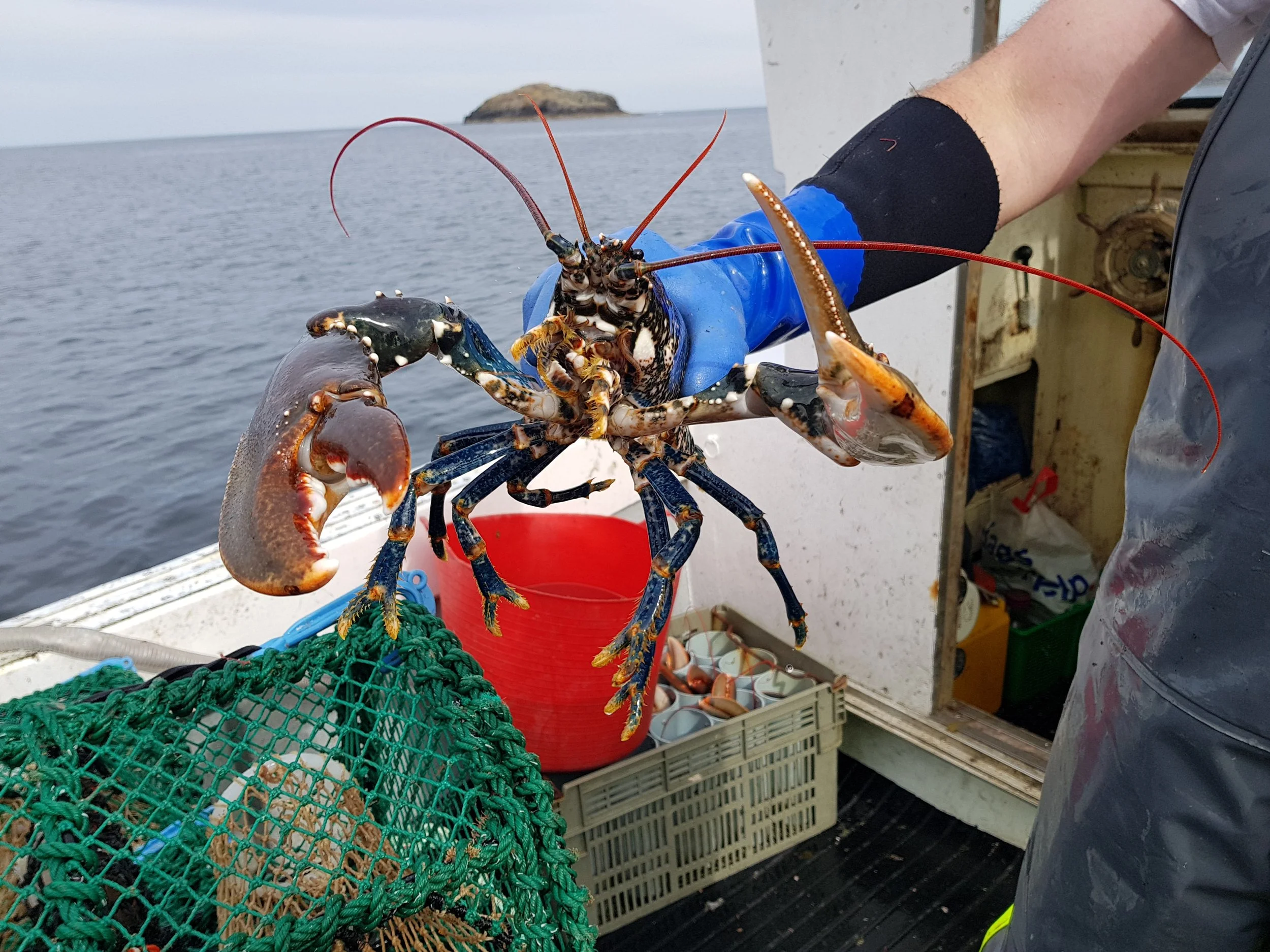
Paul Murray, local fisherman, handling freshly caught lobster in the 21st Century out on Badcall Bay.
The New Statistical Account for Eddrachillis says lobster-fishing was "carried on by a London company, who employ a number of the natives in procuring the lobsters, which they carry off alive in well-smacks to the Thames," between April and October. It adds that the lobsters were "allowed to be the best exposed in Billingsgate" (New Statistical Account, Sutherland).
The Assynt account gives the working detail. Six boats of 14-foot keel, with two men each, fished from May to August. Each set twenty or more hooped nets, baited with herring or gray fish, from sunset to sunrise. The claws were tied with packing thread, and the lobsters were kept in a perforated floating chest until the welled smacks collected them weekly. The parish produce table records 5,842 lobsters at 3d each, or £73 in total (same source).
The demand was in London. Billingsgate was a major lobster market by the early nineteenth century, and mid-Victorian writers describe supplies arriving from Norway, Orkney, Shetland and the Channel Islands, with one estimate of 1,904,000 lobsters a year (Victorian London). Well smacks, with seawater tanks built into the hull, are generally dated to the late eighteenth century (Wikipedia). While the the parish accounts do not state explicitly that this trade involved Badcall Bay, there is a clear inference that it did..
(Author’s note: The accounts do not name the London Company, and no source consulted so far has clarified this. I’ would welcome any information from local families as well as noting a further dive into other records is due)
Whether the local tables also secured lobsters is another question The Assynt account gives herring and potatoes as the chief food, and no source found so far shows lobster eaten regularly in the parish. The documented picture is of lobster as a cash crop at 3d each, sent south to a London market. while I imagine perhaps the occasional one was consumed at the wealthier tables such as the Scourie Lodge.
From herring and potatoes to the fish market
In Assynt, fishing was closely tied to the household table. The parish account drawn up in 1837 and revised in 1840 described herrings and potatoes as the people’s chief foods. It also recorded salmon fisheries on the Kirkaig and on the river running from Loch Assynt to Lochinver.
Fishing was established at Lochinver by the time the Culag station was founded in 1775. A Sutherland Estate map from 1793 marks it as the “Red Herring House”.
By the mid twentieth century, Lochinver and Kinlochbervie had become important whitefish ports. In a 1967 parliamentary debate, the previous year’s landings at the two ports were valued at just over £1 million. At that time my father was a young scientific officer at Dept of Agriculture and Fisheries Scotland based at Aberdeen but often assigned to long nights at Kinlochbervie Harbour certifying the catch. The Government minister added an important detail: the boats belonged to Moray Firth ports. A busy quay could sustain work ashore without every boat, crew or catch being local.
Heavy fishing depleted west coast herring stocks, and the west coast herring fishery was banned from 1978 to 1981. More recent oral history work in Assynt has helped bring other parts of the industry into view too, including creel fishing, scallop diving, winkle picking, harbour work and fish farming.
A view across time
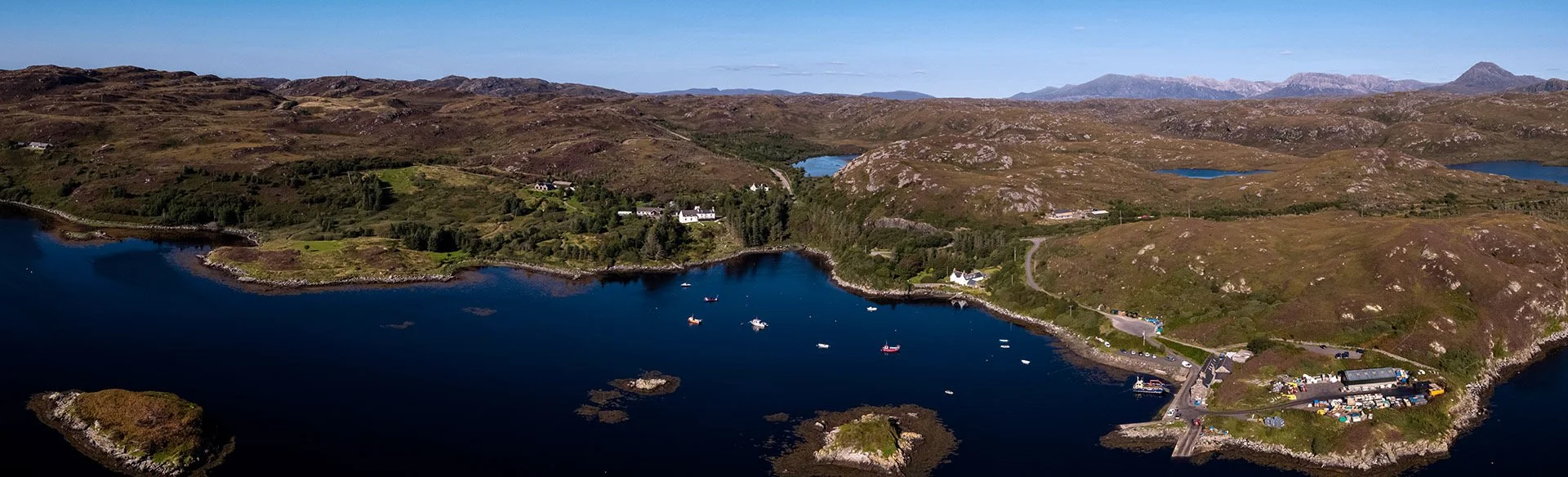
The more recent View of Badcall Bay. The pier with the salmon housed the shed behind are in the foreground, Eddrachilles Hotel, the former manse is centre. The former Doctor’s House is between the two.
The salmon house gives the story a visible starting point, but the continuity is in the working shore, not in an unchanged way of producing fish. Today’s salmon are farmed; the older accounts describe people fishing wild shoals and working seasonal fisheries.
From the hotel, the building across the bay is a reminder that fishing has always involved more than going to sea. A catch had to be landed, kept, sold or brought to the table. Around Badcall, Kylestrome, Glendhu and Lochinver, that work has taken many forms.