The Castle Dog: Our Gordon Setters at Eddrachilles
Beautiful, loyal and splendidly stubborn, the Gordon Setter was developed for Scotland’s demanding landscape. Through Bydand and five-month-old Loki—Eddrachilles’ aspiring junior doggy concierge—we explore the history and character of the Castle Dog, and what these remarkable dogs bring to hotel life.
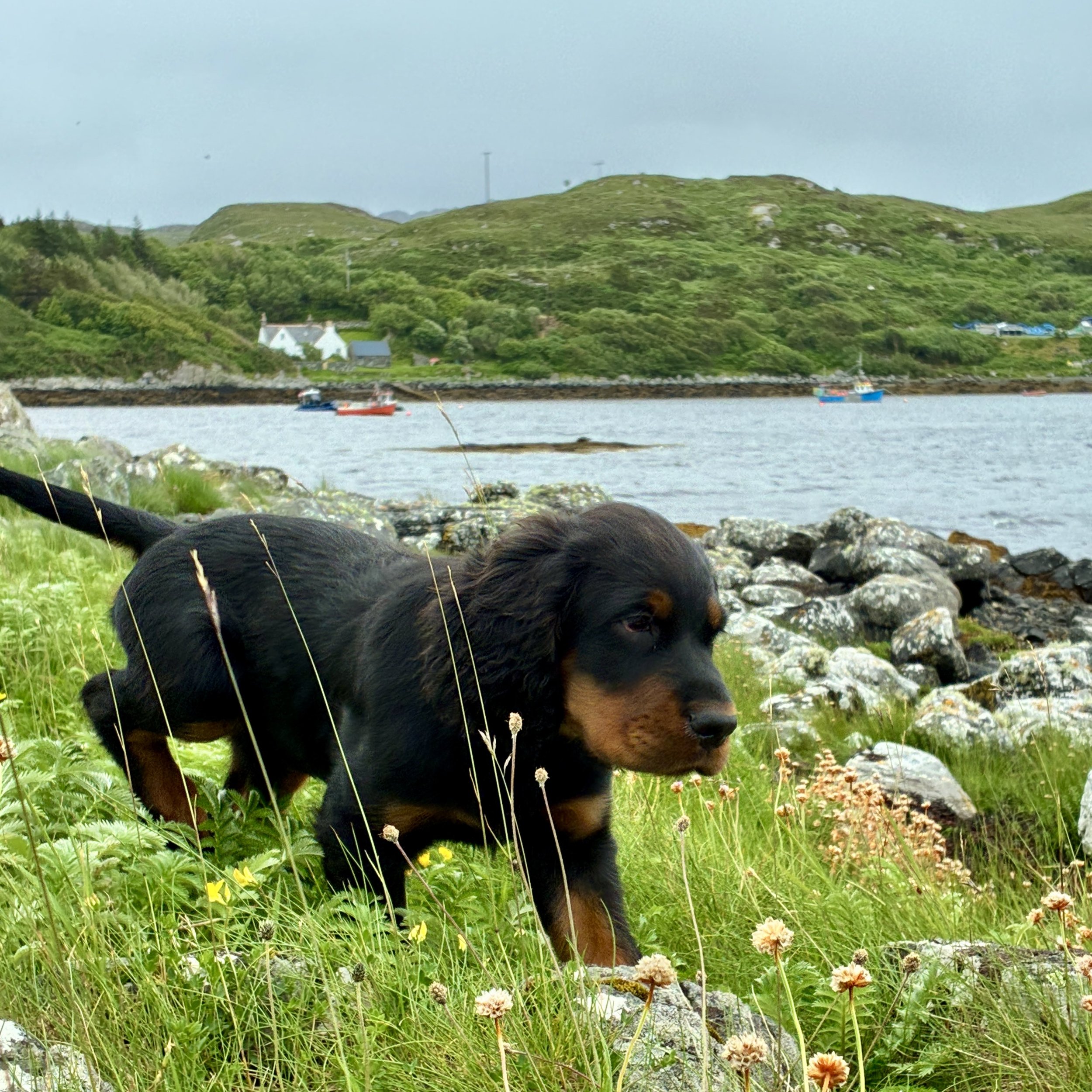
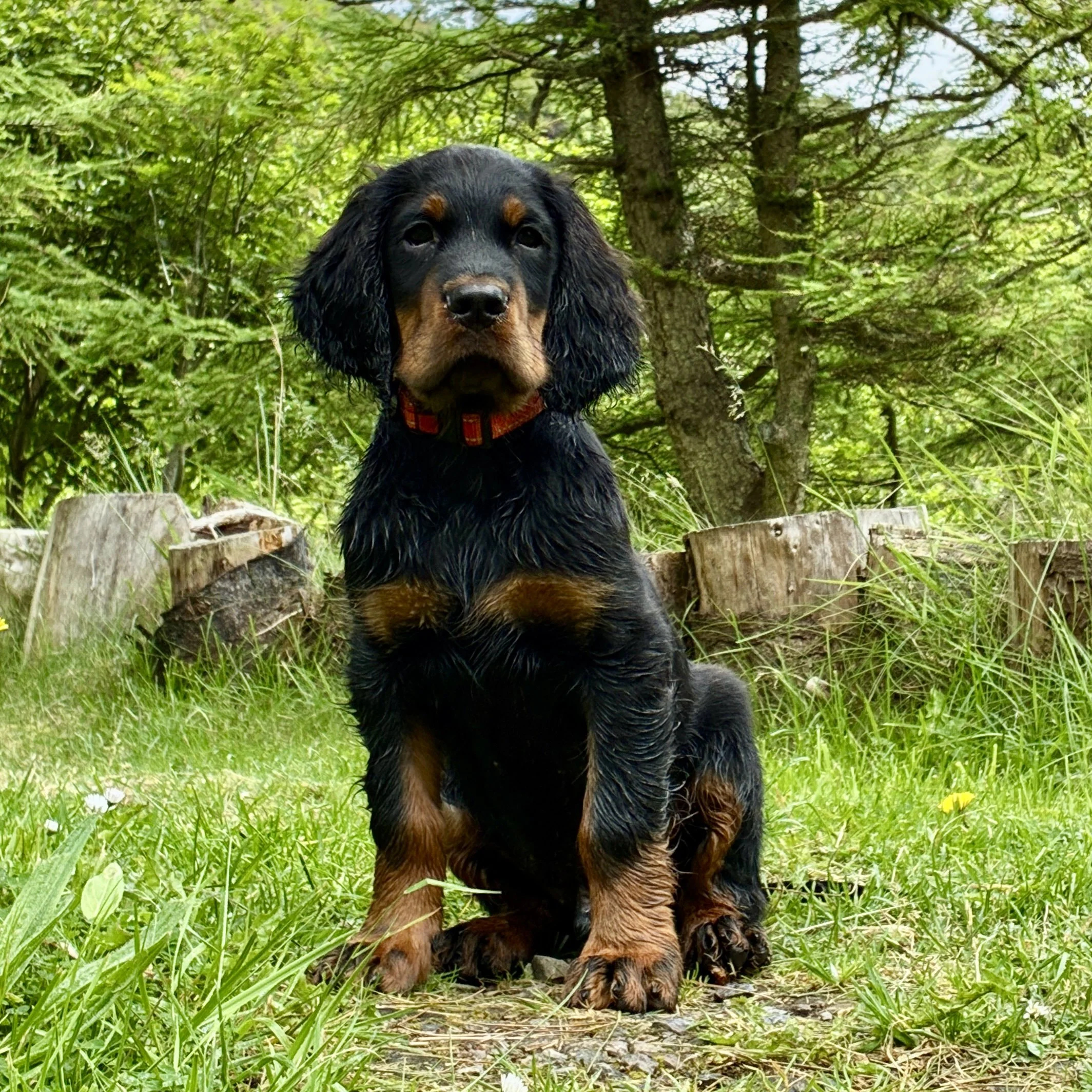
Young puppy Loki on shore patrol
At Eddrachilles, a small hotel on Scotland’s remote north-west coast, the weather is part of the household. Atlantic rain can arrive in silver curtains, rattling against the windows and darkening the lawns within minutes; then the cloud lifts, the sea flashes pewter beyond the garden and the wind carries the clean, mineral smell of salt, wet grass and peat.
On bright days, the far headland of Assynt with its mountains seem close enough to touch. On stormier ones, the hotel becomes a warm island of lamplight, tea or coffee served with our compliments in Highland Stoneware, and quiet fireside corners.
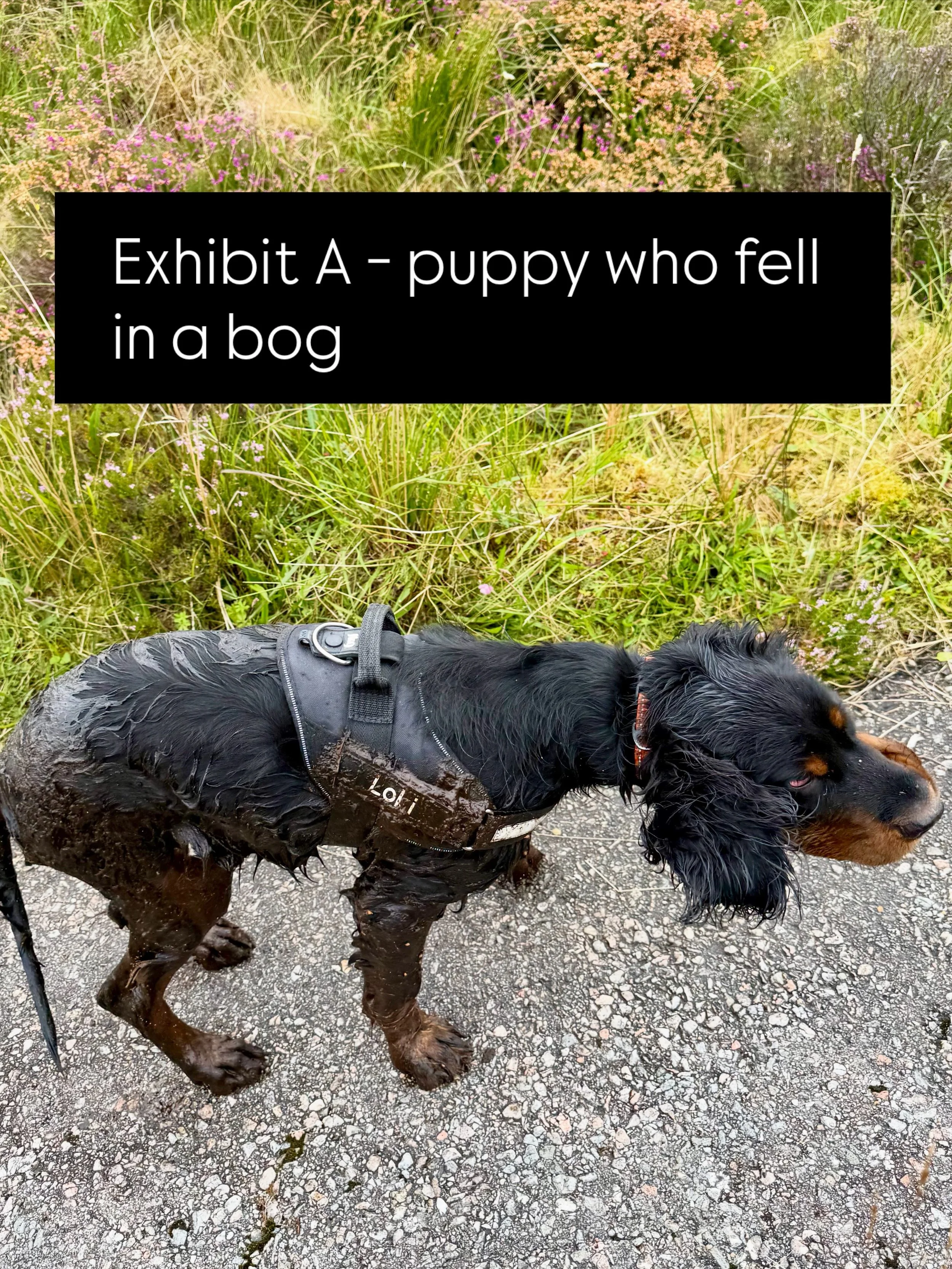
This is the landscape into which Loki, our young Gordon Setter, is growing. Now five months old, he patrols the grounds with increasing confidence, stands with his nose raised to messages carried in from the sea and investigates the wetter, sea weed strewn edges of the grounds with particular enthusiasm. His paws return bearing rain, grass, seaweed and a quantity of Highland mud entirely disproportionate to their size.
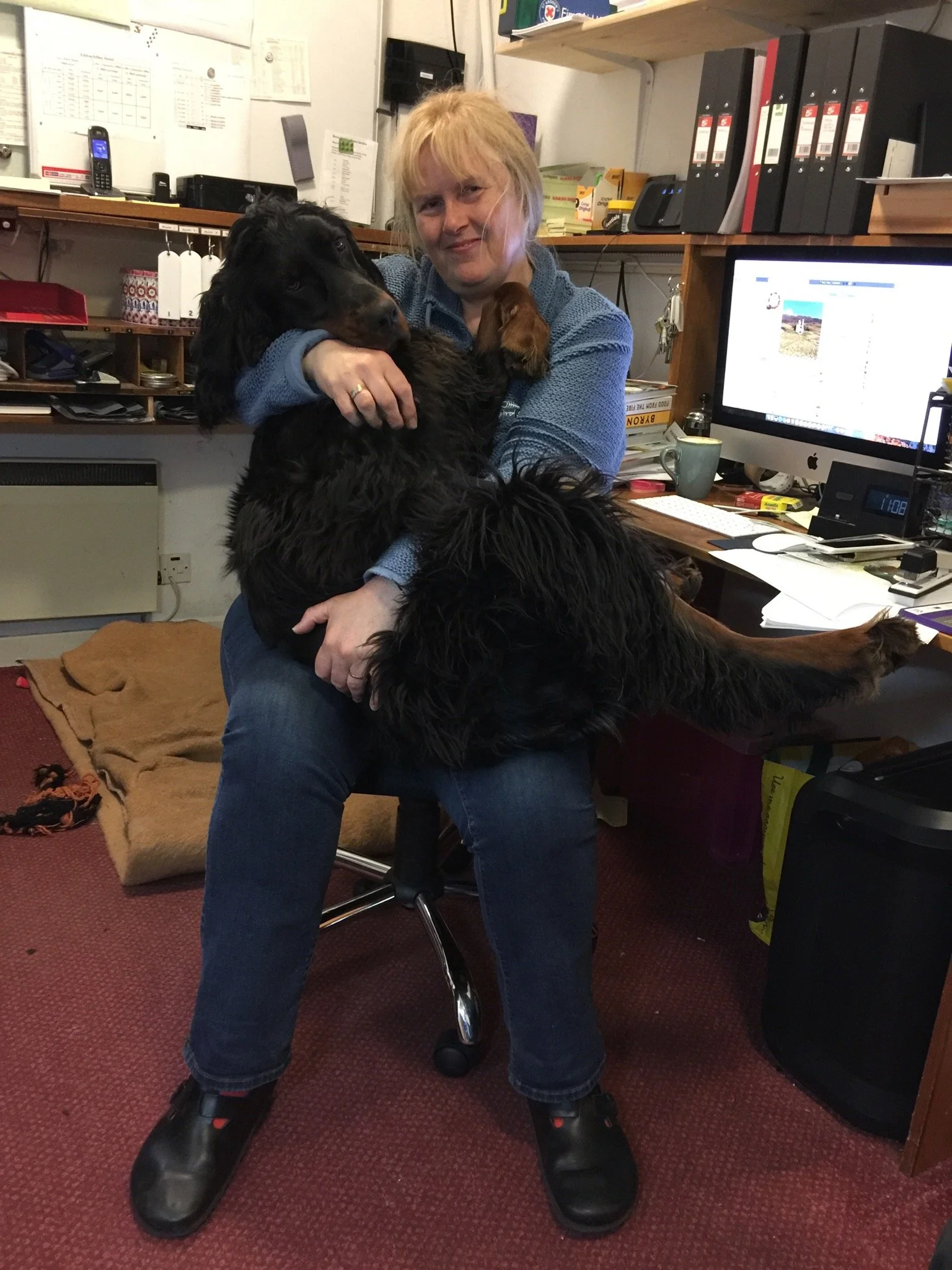
Loki also has ambitions towards the front desk, although his appointment as junior doggy concierge remains highly provisional. His visits inside the hotel are still occasional and carefully supervised. He has not yet mastered the finer points of restraint, dignified greetings or passing an interesting object without putting it in his mouth.
Those behaviours will be a winter training project, particularly with a family gathering planned for Christmas. Whether Loki will regard the Christmas tree as a seasonal decoration, an indoor woodland habitat or an unusually generous collection of toys remains to be seen. His training is expected to be long term.
His career began with a short, rather silly video showing him attempting some rudimentary exercises before taking his first official exploration of a hotel recommended dog walk (we have maps for guests). We posted the video without great expectations, largely for a few regular followers who are as passionate about dogs as we are. Within a couple of days, however, it had been watched several thousand times and brought new followers to the hotel. Evidently, Loki already has a celebrity fan-club.
His formal Kennel Club name is Elegance Noir of Bonnienicht. At home, he is Loki McTumshie of Eddrachilles: a puppy with a talent for mischief, a growing sense of importance and the unmistakable colouring of one of Scotland’s oldest native dog breeds.
The Gordon Setter, sometimes affectionately known as the Castle Dog, takes its name from Gordon Castle at Fochabers in Moray. There, Alexander, Fourth Duke of Gordon, developed the setter line associated with his name during the early nineteenth century, roughly the same time as the large manse at Badcall, now Eddrachilles Hotel was being established. The Duke—known as the “Cock o’ the North”—did not invent the black-and-tan setter, but his kennels helped establish the substantial and enduring dog from which the modern breed developed.
The Duke was a man of broad interests. He developed Fochabers as a planned estate town, enlarged Gordon Castle and supported Scottish music and culture. In 1794, he and his formidable wife, Jane, Duchess of Gordon, helped raise the regiment that became the Gordon Highlanders. She reputedly gave a kiss to every man enlisting!
That association has particular meaning for us. Richard’s Officer Training Club at Aberdeen University was associated with the Gordon Highlanders (although he was already a sponsored officer with Royal Corps of Signals). Our previous Gordon’s full name was Lourdace Bydand of Eddrachilles. “Bydand”, the motto of the Gordons, means steadfast: to keep going, whatever the difficulties. It suited him very well.
The setters developed at Gordon Castle were made for serious country. They had to search for game across long stretches of rough ground, working through heather, bog and dense cover where birds might be scattered and every opportunity mattered. Speed alone was of limited use. Substance, stamina and steadiness were prized.
That purpose remains visible in the Gordon today. The breed standard describes a stylish, symmetrical dog with “galloping lines”, built rather like a weight-carrying hunter. The coat is deep, shining black, with clearly defined markings of rich chestnut red around the muzzle and eyes, on the chest and legs and beneath the tail. The eyes are dark brown, bright and intelligent. Movement should be steady and free, with plenty of drive from behind.
Early dogs at Gordon Castle were not uniformly black and tan. Some were black, white and tan, and the breed’s development was rather less tidy than later pedigrees might suggest. What eventually emerged was a dog visually distinct from the paler English Setter and brilliant red Irish Setter: darker, heavier and perhaps more deliberate, but still possessed of considerable elegance.
Gordons are the heaviest of the setter breeds, although not every individual has consulted the official measurements. The standard suggests about 66 centimetres and 29.5 kilograms for a male. Bydand, from distinguished Scottish lines and unmistakably a Gordon, was considerably larger. In his prime he weighed between 42 and 45 kilograms.
He was not overweight. He was tall, lean and extraordinarily well muscled; even when arthritis began to diminish the power in his hips, his vets still remarked upon his condition. He ate heartily and stole food whenever opportunity presented itself, but there was nothing soft about him. He was simply a very large and powerful example of the breed.
Gordons travelled successfully beyond Scotland. Two dogs from the Gordon Castle kennels, Rake and Rachael, arrived in America in 1842 and helped establish the breed there. The Gordon Castle Setter was among the first breeds in the early American registry later inherited by the American Kennel Club. Even now, American guests at Eddrachilles often recognise a Gordon more readily than British visitors do.
The breed is also familiar in the Nordic countries as a working dog. When Bydand was young, we employed a Swedish chef who had spent time with the army in northern Sweden. He was mildly appalled to discover that ours was being kept as a pet. In his opinion, a dog of such heritage should have been earning its keep.
More recently, European bloodlines have become increasingly important to British breeders. Both sides of Loki’s pedigree bring Czech and Slovak heritage into a British population now small enough for the Gordon to be listed among our vulnerable native breeds.
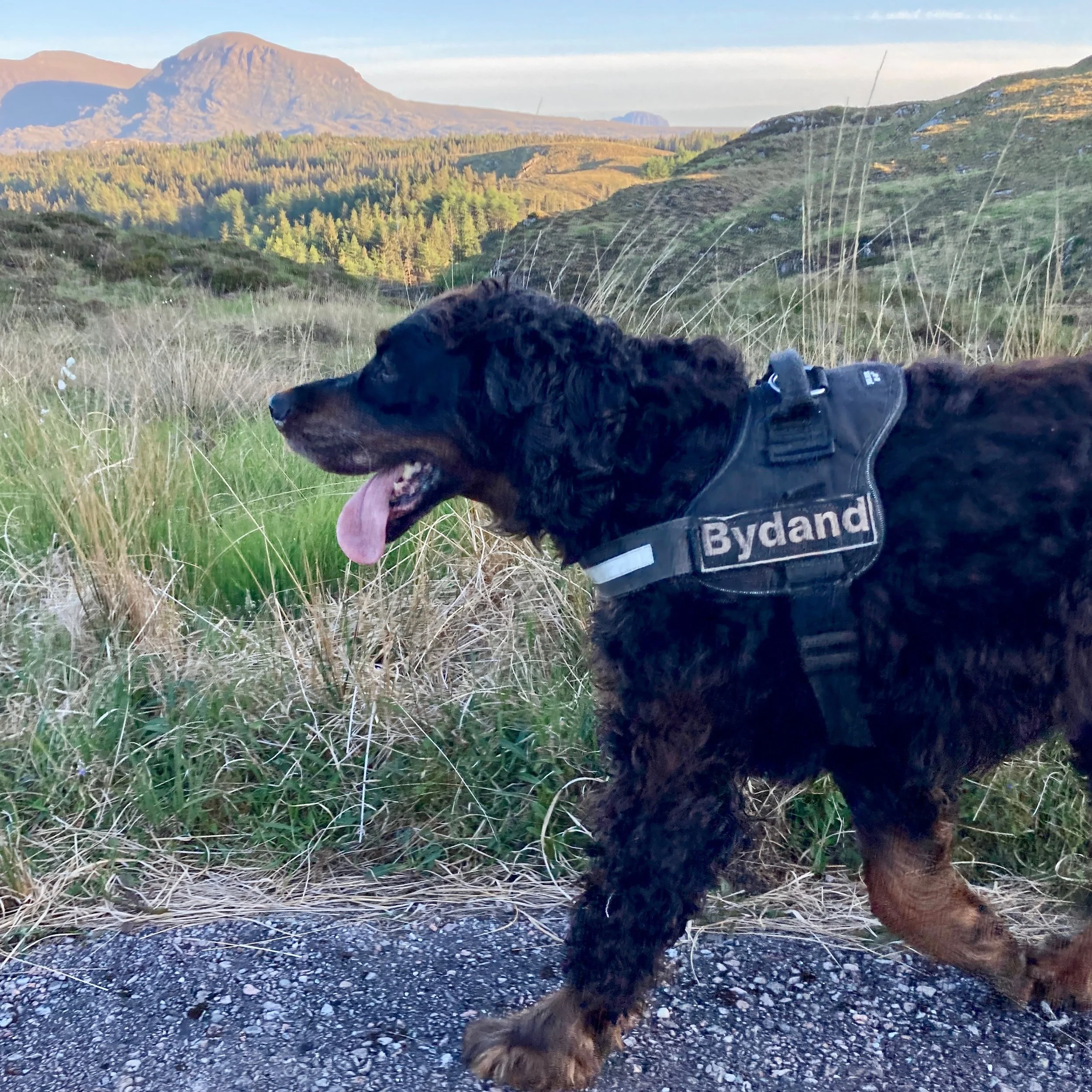
Bydand, our first Gordon Setter, perfectly at home in Sutheland’s vast landscapes
There is even a persistent tale among American Gordon enthusiasts that the breed helped inspire Disney’s Goofy. It is an enchanting piece of breed folklore rather than established history, based on Walt DIsney’s childhood family dogs being Gordons. However, anyone who has watched a young Gordon moving through life can understand its appeal. “Goofy” is a description that arrives remarkably readily.
Gordons are famously slow to mature. Breed books sometimes suggest three years. Our experience indicates that four may be more realistic - and even then maturity in a Gordon is relative. . When people used to ask when Bydand would finally grow up, I would tell them that I believed it would happen at around fourteen.
Living with a Gordon is not, despite the aristocratic appearance, an entirely stately experience. They are fond of peat bogs and water, and equipped with paws capable of absorbing an improbable quantity of dirt. Grooming is endless. Sofas are colonised. Kitchen counters must be defended against an extendable neck followed by still more remarkable quantities of tongue.
They are also stubborn. A Gordon does not necessarily disobey an instruction. He takes it into thoughtful consideration before deciding whether compliance is warranted.
Recall has been the exception in our experience. For all their independence, Gordons are profoundly attached to their people and seldom wish to lose sight of them for long. They may like others, but their deepest loyalty is reserved for those they regard as their own. At Eddrachilles Bydand remembered former members of staff years after they left and are particularly relaxed, affectionate and foolish among their extended family. They have also, in our household at least, shown a proper respect for cats. Whether the cats reciprocate is another matter.
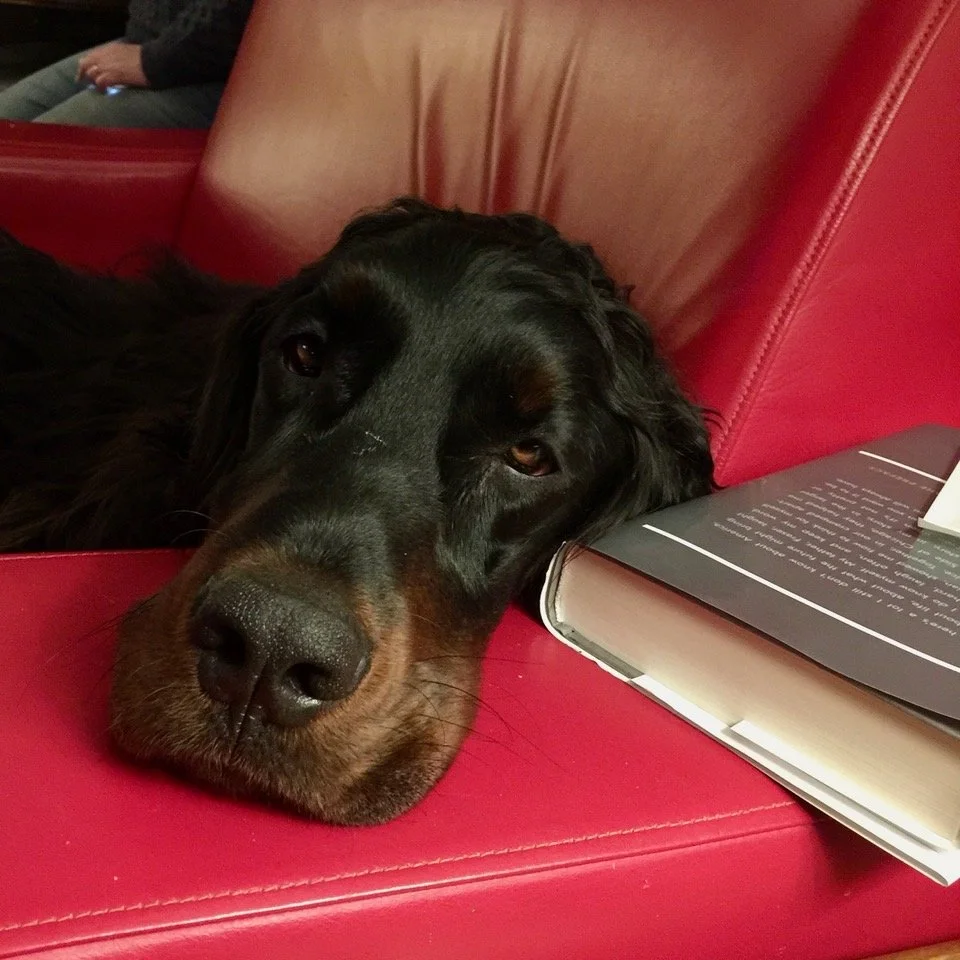
Bydand was not a natural performer for guests. He was naughty and earned a lifetime ban from the building. His contribution to hotel life took place largely behind the scenes. Staff who were homesick, unhappy or simply in need of company took him walking in the evenings. He listened without offering advice and never repeated anything he was told.
When Dusy, our much loved former team member, visited Eddrachilles recently, she summed up his place here in one sentence: “When I worked here, Bydand was my best friend.”
He was one of the team and, in his own way, a perfect hotel dog.
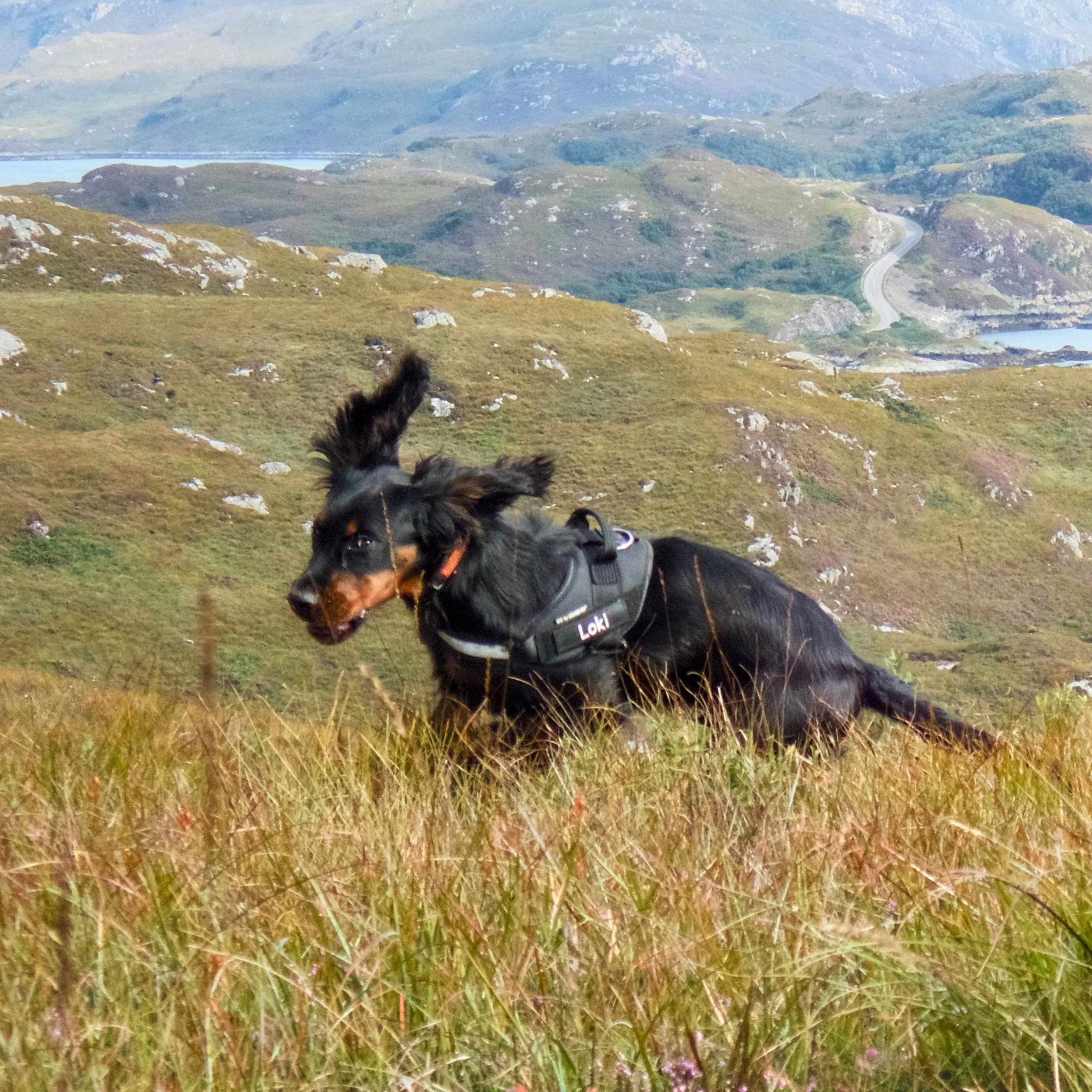
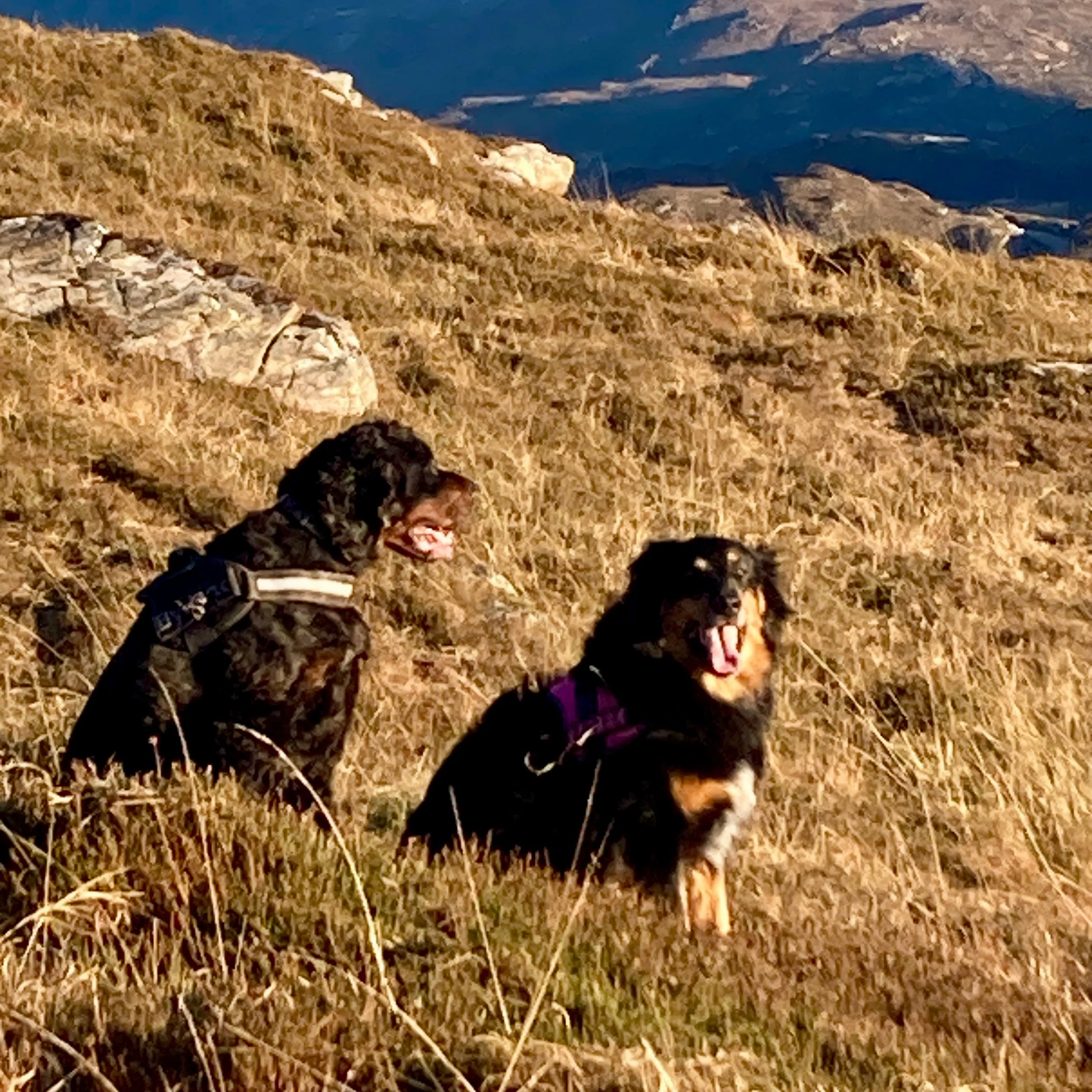
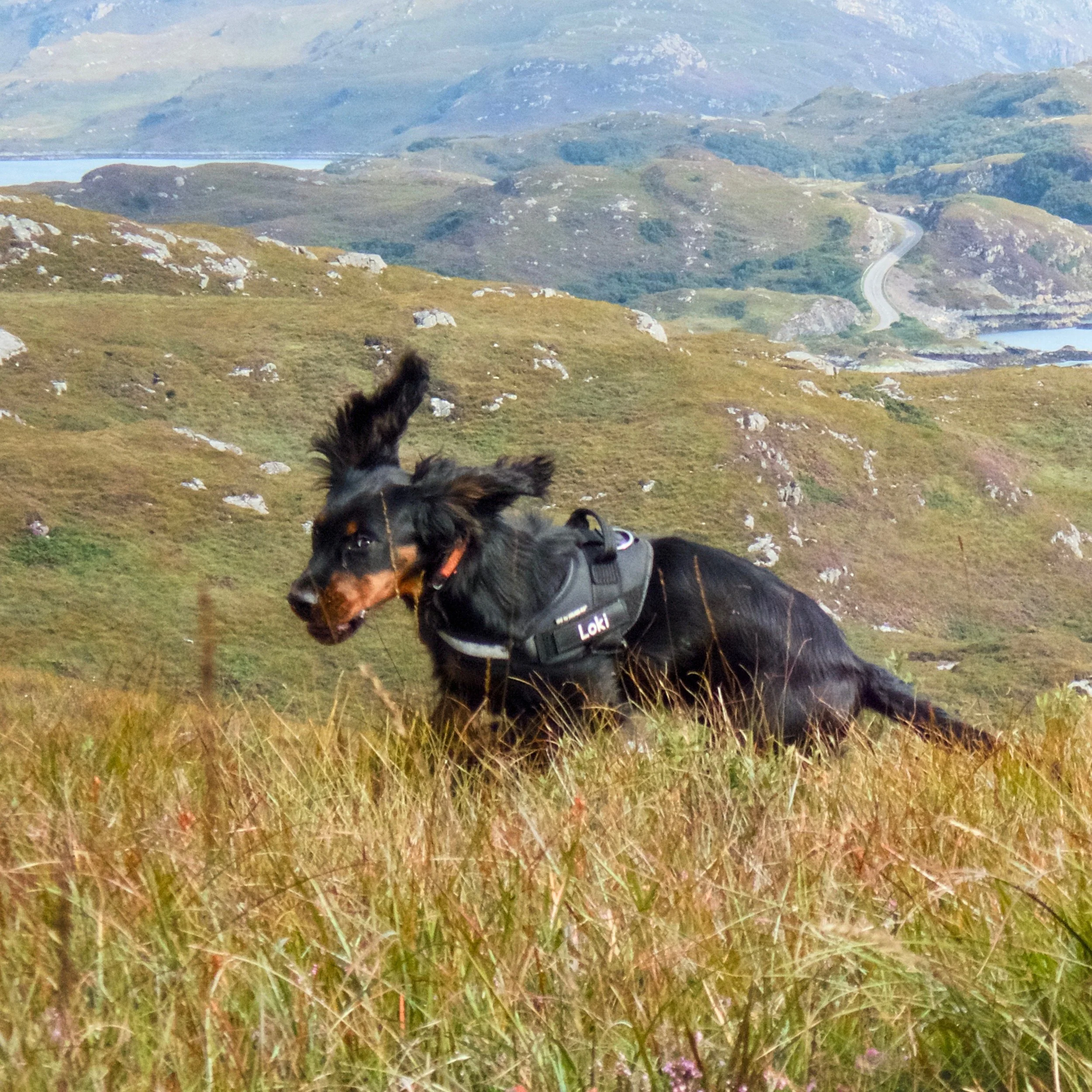
Loki at 5 months returning on a recall. The NC500 is visible in the background on its way towards Kylesku
Loki may be developing a different interpretation of the position. Earlier this season, a Scottish guest, visiting from Ohio where she settled thirty years ago, asked whether she might meet him before checking out. She had seen him on our Facebook page. Decades earlier, before emigrating, she had raised her children in Scotland with a much-loved Gordon Setter as the family dog.
Loki was brought into the guest lounge and appeared to know immediately who was waiting for him. He ran straight to her. As she stroked him and whispered to him, she was moved to tears—not simply by the puppy in front of her, but by the sudden return of belonging, home, family and a deeply loved dog from another period of her life.
Perhaps that is the real qualification for a hotel dog: not perfect obedience, immaculate paws or an indifference to unattended food, but an instinct for knowing when someone has come especially to see you.
Loki’s suitability for hotel life remains under review—but, on the evidence of his “assistance” to one lady from Ohio, junior concierge may not be an entirely fanciful appointment after all.