History and Heritage, Reflections by Fiona Fiona Campbell Trevor History and Heritage, Reflections by Fiona Fiona Campbell Trevor

Under St Andrew’s Cross

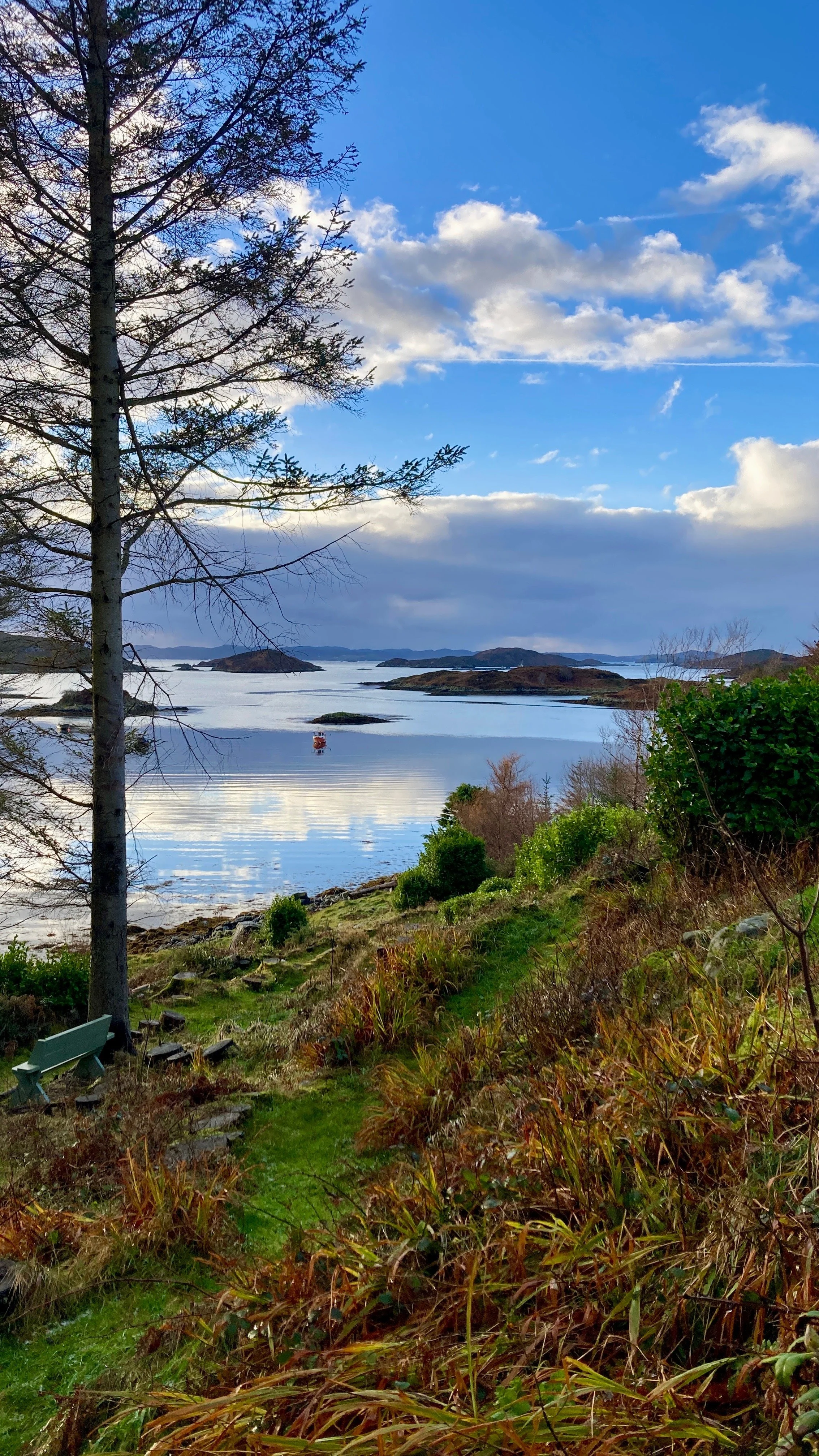
From hotel path looking down and out across Badcall bay and its islands to the coast of Assynt.  Day fishing boat with orange hull is moored close to the shore. Sunshine blue skies but with clouds and an incoming band of rain.

View from a hotel path down to the shore in late November.

St Andrew’s Day arrives gently in the north-west this year: soft winter light on the water, a trace of warmth in the mid-day sun, and our hardy native “warrior” birds hopping contentedly over the soil as we clear the spent foliage. My thoughts drift to the significance of Scotland’s patron saint, and the long tradition of welcome that lies at the heart of this former manse.

The stories of St Andrew are older than Scotland itself. A fisherman by trade, known not for status but for kindness, he became the patron saint of travellers, those who seek refuge, and those who offer hospitality. He is woven through centuries of Highland life — not through grandeur, but through the simple belief that every guest should find warmth in the welcome at the door.

That feels close to the spirit of Eddrachilles.

For much of its life, this house belonged to the Church of Scotland, whose emblem placed the burning bush on the cross of St Andrew. In another chapter of our family story, the same saltire cross formed the base of the badge worn by the Scottish Horse regiment on the far fronts of the First World War — a quiet invocation of national identity and the protection of their patron saint as they travelled to Gallipoli, Egypt, Jordan and Jerusalem. In those years, there was no contradiction between the Saltire on the uniform and the “lucky” sovereign or half-sovereign carried in a pocket, bearing St George, patron saint of England, on horseback. That coin reminded its bearer of Great Britain, of King and of the United Kingdom for whom they fought — loyalties that steadied men in difficult times.

Today, in the peace of this landscape, we can remember St Andrew for the welcome he represents: the generosity that comforts and nourishes a traveller, the shelter found in a remote place, the hospitality offered without fuss.

From Badcall Bay, we wish you a peaceful St Andrew’s Day — and the warmth of a house that was once built to welcome its congregation and strangers alike, and still hopes to live up to that calling.

Fiona Campbell Trevor is co-owner of Eddrachilles Hotel, a former Church of Scotland manse overlooking Badcall Bay. She writes occasionally about the heritage, landscape and quiet rhythms of life in the far north-west, and the traditions of welcome that continue to shape this place.

Read More
History and Heritage, Reflections by Fiona Fiona Campbell Trevor History and Heritage, Reflections by Fiona Fiona Campbell Trevor

Between the Kyles: Remembrance Week

From Eddrachilles Hotel on Scotland’s north-west coast, a reflection on remembrance in the Highlands — honouring those who served, those who returned, and those who still serve today.

Fiona Campbell Trevor co-owns and runs Eddrachilles Hotel with her husband Richard. From their home by the shore of Badcall Bay she writes the Eddrachilles Journal, reflecting on Highland life, hospitality, and heritage — and on the people whose courage and care continue to shape this place.

Remembrance Week:  In the quiet of November, as the days shorten and life slows, personal reflection and remembrance come easily here, alongside respectful community tributes of poppies.

Lochinver War Memorial in Sutherland, surmounted by a bronze figure of a Highlander. The memorial commemorates local men who served and fell in the First World War and later conflicts, echoing the region’s deep ties to the Seaforth regiment.

Lochinver’s war memorial, — one of many tributes across the Highlands to courage and loss

The war memorials at Scourie, Kinlochbervie, Durness, and Lochinver are today as much part of the landscape as the lochs and moors themselves. Across the North and West Highlands, the names recorded on stone war memorials tell of crofters and fishermen, shepherds, engineers, and schoolteachers. The surnames of the fallen are so often the same familiar names we hear today in our communities. Each name a member of a household once filled with laughter, then marked by worry, waiting, and grief. A story tragically repeated across the Commonwealth.

Eddrachilles War Hero and Memorial Champion

Alongside our remembrance this week for those who died in the World Wars or conflicts since, there is also deep respect for those who fought and returned, their battles to “win the peace” and build that better tomorrow. Among them was Lt Colonel Thomas Wilkinson Cuthbert CMG DSO, a former owner of the old manse that is now Eddrachilles Hotel. A Territorial (Volunteer) officer in the 4th Seaforth Highlanders, his local Ross-shire battalion of the Territorial Force. went out to France with the battalion in October 1914, one of the first Territorial battalions to serve overseas.

A Major on departure from Britain, he led his men through the early battles of the First World War, assuming command at Neuve Chapelle after his Colonel was wounded, and continuing despite his own head wound. By coincidence, his award of the DSO is listed in the London Gazette a few entries from the report a posthumous award to a member of my extended family (Gordon Highlanders).

The grave of Lt Col Thomas Wilkinson Cuthbert CMG DSO, Seaforth Highlanders, in the woodland grounds of Eddrachilles Hotel

Colonel Cuthbert returned home after the war but, like so many of his generation, carrying the weight of those he could not bring home. His purchase of Eddrachilles in the 1920’s for his retirement may have been part of his healing process.

In his later years Colonel Cuthbert worked tirelessly to preserve the battalion’s memorials and records — ensuring that the courage and losses of the Seaforths were not erased by time.  While the Seaforth name has long since been subsumed, their traditions continue today within 4 SCOTS, The Highlanders, Royal Regiment of Scotland. His grave, overlooking the sea here in our woodland grounds, is a quiet reminder of his legacy.  Among the first plantings we undertook at Eddrachilles were those in “The Colonel’s dell” and the hotel’s main lounge is called “The Colonel’s Lounge” in his honour.     Rest at ease, sir, Rest at ease.

“It all happened again…”

The X-Craft Submariners’ Memorial at Kylesku, beside the bridge in North-West Sutherland. A stone cairn honouring Royal Navy midget-submarine crews who trained in these waters during the Second World War.

The X-Craft cairn at Kylesku, where Royal Navy midget-sub crews once trained in secret before their daring missions.

The Second World War took another generation away from local homes but also in secret brought others to this area for highly specialist – sometimes deadly -  training. Near Kylesku young men trained in absolute secrecy for one of the war’s most daring ventures. The human torpedo or X-Craft crews — the Royal Navy’s midget submarine units — practised in Loch Cairnbawn before setting out on perilous missions beneath enemy ships. Their courage and endurance were tested in silence, in darkness, and in cold northern seas.  Their most famous mission was a thousand hard miles from Kylesku in the daring X-Craft raid on the German battleship, the Tirpitz, in a Norwegian fjord.

The cairn memorial to these submariners is located at the edge of the northern carpark by the iconic Kylesku bridge. It’s one of our highly recommended mini-visits for guests.  (improved information panels were recently installed).

Recent conflicts

Today, the faces of those who serve in the Armed Forces are women and men from every background, some still with Highland roots, who carry forward that same sense of duty. Their service — whether in uniform, in peacekeeping, or in humanitarian work — belongs to the same long line of courage and care.

In remembering here on the coast, our own thoughts also turn to one of our earliest Head Chefs at Eddrachilles who had previously served as a UN peacekeeper — a Swedish soldier injured on active duty and honourably discharged, who found a sense of belonging again in the kitchen brigade.  Though illness cut short his career here, and ultimately his life, he remains an inspiration to us in our stewardship of Eddrachilles.

:** Evening light over Badcall Bay, North-West Sutherland, viewed from the grounds of Eddrachilles Hotel. The still water and fading light symbolise reflection and remembrance in the Highlands.

Badcall_Bay_Sunset_Eddrachilles_Remembrance.jpg

Remembrance in the Highlands is not about pageantry but simple gatherings. It comes to us in the silence of the bay at dusk, the placing of a single poppy by a lichen-covered stone, the dawn light warming the winter light on the water and the annual gatherings by the local was memorial. It asks for gratitude, not glorification. These were - and are - ordinary people asked to bear extraordinary things. Their endurance, humility, and sense of belonging to something greater than themselves remain lessons for us all.

As the sun sets on the North West coast and when the first rays dance upon the water, the words of the old verse still ring true:

“At the going down of the sun, and in the morning, we will remember them.”


Editor Note: the parish place name Eddrachilles — derived from the Gaelic *Eadar Dà Chaolas” means “between the kyles” or “between the narrows”, a reference to the sea channels at Kylesku and Laxford,or originally by Durness, which defined a Parish served by the old manse, now hotel.

Read More