Seventy Yards of Flex and the Elsan
The years spent as a youth hostel, 1950–1958
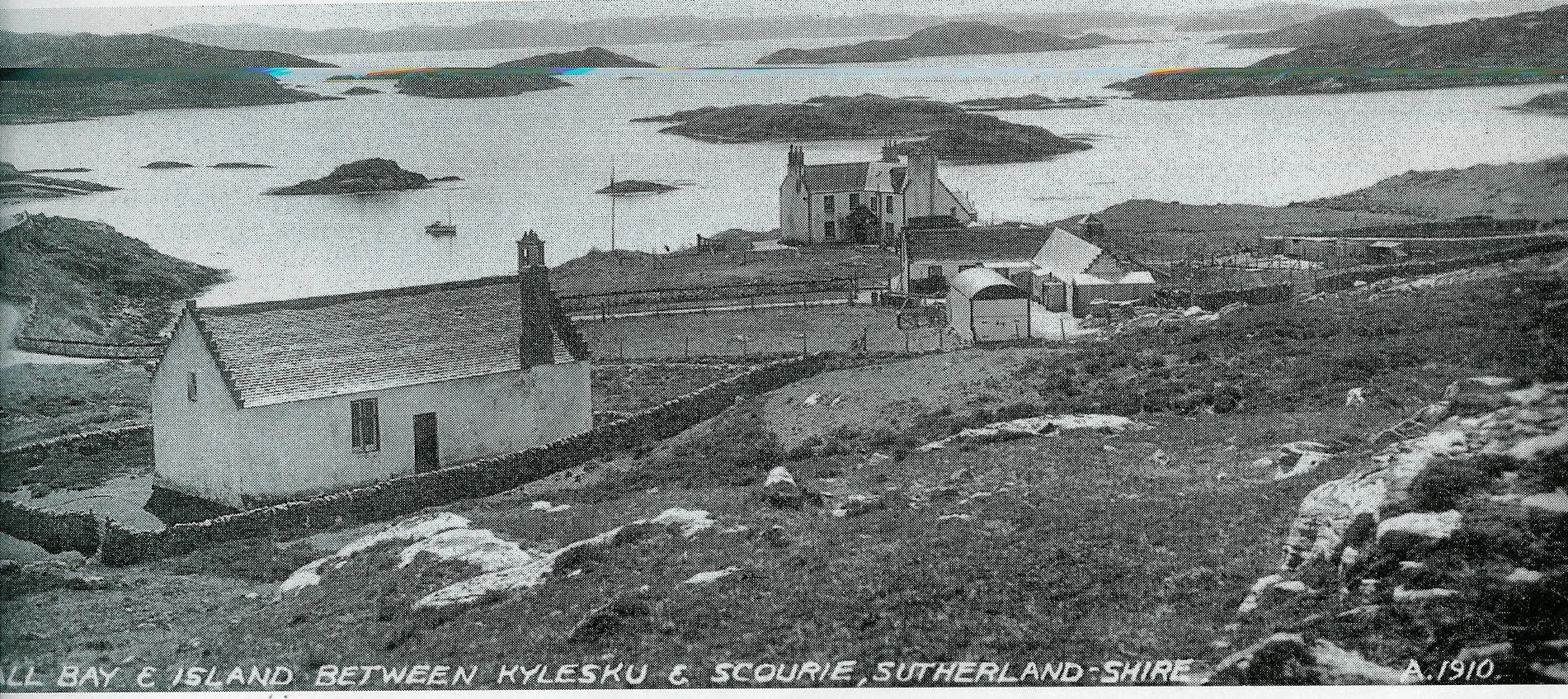
Old postcard style photo showing the church, manse and grieve’s buildings in the centre. Those formed the eventual Youth Hostel
Buildings accumulate lives. The white manse overlooking Badcall Bay that is now Eddrachilles Hotel has been, in its time, the home of Church of Scotland ministers, the retirement retreat of a decorated First World War colonel, a wartime refuge, and — for nine seasons in the 1950s — a youth hostel. Or rather, the rather more comfortable annexe to one.
We have known the broad outline of this chapter for some time. It was also mentioned in The Herald’s report when we The Good Hotel Guide awarded Eddrachilles Hotel Best in Scotland, 2023. But the detail, as is often the way with detail, was elsewhere — in this case in the archive documents of the Scottish Youth Hostel Association, which record the hostel at Eddrachilles from its hopeful opening in 1950 to its pragmatic closure in 1958 with a candour that is, eighty years later, entirely charming.
What follows is drawn from those primary sources: SYHA minutes, a general secretary’s inspection report, building committee notes, annual reports, and a set of occupancy figures that tell, quietly but clearly, a story the committee minutes do not always acknowledge.
A Link in the West Coast Chain
The Scottish Youth Hostel Association established facilities at Eddrachilles in 1946, as part of a sequence of new hostels intended to provide “a link in the chain up the West Coast.” Tongue and Durness completed the run northward. This stretch of Sutherland was, even by Highland standards, remote — the road improvements that would eventually make it genuinely accessible were still decades away. Fiona’s father, now approaching 90, remembers the excitement of being collected by his father from boarding school in Perthshire at the school year end and setting out on a true adventure through the west Highlands, especially north of Ullapool.
Alterations to the existing buildings were recorded in the SYHA minutes of 1950, and a new 20-bed hostel was hoped to open on 13th May of that year. It opened on 1st July. In the context of northwest Highland logistics, this was broadly on schedule.
The hostel occupied the buildings previously used by the grieve — an L-shaped stone building, crow-stepped, with an overloft — one of a small cluster of three Church of Scotland buildings at the northeast tip of Badcall Bay. The cluster comprised a small church, the grieve’s house, and the manse. A corrugated iron hut of uncertain origin at the southwest end of the Grieves House housed most of the hostel facilities. The former manse, the future Eddrachilles Hotel, served as the warden’s residence. This distinction would prove significant.
The Warden and the Spirit of the Youth Hostel Movement
Mr MacLeod, appointed warden on a commission basis in 1950, comes to us through the measured prose of the SYHA’s General Secretary, a man named Cromar, who visited on 18th May 1951 to assess the hostel’s readiness for the coming season. His report is a small masterpiece of careful institutional writing.
Mr MacLeod, Cromar noted, struck him as “quite a capable man” who had, moreover, “been infected by the spirit of the movement.” This was high praise. It was followed, with barely a pause, by the observation that owing to his many other occupations, the warden was “unable to give the hostel as much attention as the committee might wish.”
“If all members were perfect, the system would work very satisfactorily. But in a certain number of cases — by no means the majority — members will get away with it.” — General Secretary Cromar, May 1951
The general procedure, Cromar explained, was for Mr MacLeod to come over in the evening, collect the cards and money, while members called at the house to learn their assigned duties for the following morning. It was a system that relied, as Cromar noted with wonderful understatement, on members behaving correctly. He had put up a pep notice. A copy, he added, would be read at the meeting.
When the hostel was full, Mr MacLeod generally “fixed up members in the house or barn.” He had also, Cromar noted approvingly, supplied his own Tilley lamp for the hostel. A man of resource, if not of surplus time.
Seventy Yards of Flex
Electricity at the hostel was supplied by a length of flex run from the mains. Mr MacLeod reported that he had seventy yards of it, sufficient to run a light to the common room. For everything else, there were Tilley lamps. This arrangement was later confirmed as “primitive” by people who had actually stayed there, though one imagines that walkers who had chosen to holiday in a corrugated iron hut three miles south of Scourie had calibrated their expectations accordingly.
The Elsan Question
Cromar’s 1951 report devotes considerable attention to the toilet arrangements, which had “not been improved since last year.” Inspecting the building, however, he had found a small room near the entrance which had originally been used as an Elsan closet. With the assistance of a new member who happened to be present at the time, he had relocated the Elsan into this room, which had, he noted, “quite good ventilation.”
“As we had no tools, however, and very little skill,” he added, “the job is rather amateur.”
The relocation freed the lean-to shed for use as a washing area, with separate sections for each sex. There were as yet no basins. He had accordingly written to the accountant to forward some. A local carpenter’s quote of £17 for various small repairs was considered and judged unjustified.
A Better Class of Guest
One detail in the records rewards particular attention. Guests considered to be “a better class” were invited to stay not in the hostel buildings but in the warden’s house — the manse itself. Whether this represented official SYHA policy or simply Mr MacLeod’s personal reading of his guests’ requirements is not recorded. Either way, the building that would eventually become Eddrachilles Hotel was already operating, in an entirely unofficial capacity, as the better quality hospitality option.
The Numbers
Despite the Elsan, the flex, and the pep notice, the hostel was genuinely well used. The occupancy figures recorded over its nine seasons of operation - and long before the promotional power of the North Coast 500 - are remarkable:
1950: 42 (opening season, July only)
1951: 1,057
1952: 996
1953: 1,051
1954: 1,195
1955: 1,247
1956: 1,020
1957: 1,237
1958: 1,160
Over a thousand bed nights annually, consistently, through the whole decade. The hostel was not failing. The building was.
Derelict, Yet Busy
By 1953 the premises were described as unsatisfactory, and budgeted improvements had not been carried out. The committee briefly considered purchasing Roseville, a house with a shop and garage in Scourie, as a replacement, offering £750 for the house alone. The reasons are unknown but this scheme came to nothing.
In the background, the SYHA had been quietly pursuing a more ambitious idea: acquiring the manse itself. The General Secretary had approached the trustees of the late Colonel Cuthbert — Lieutenant Colonel Thomas Wilkinson Cuthbert CMG DSO, who had purchased the former manse in the 1920s for his retirement and died there in 1936 — about the possibility of transferring the hostel to the former manse as the more substantial building next door. The trustees declined. The terms of the Colonel’s trust, it emerged, were restrictive.
In fact, the trust had been established with a specific purpose: a nursing home. The manse, in the Colonel’s expressed wishes, was to become a place of rest and recuperation for nurses. It was a generous intention. It was also, as the trustees had discovered over the preceding two decades, legally impossible to give effect to. Plus, the good nurses of Scotland were as yet unconvinced of the charms of a holiday in such a remote location with a difficult journey. The resulting tangle had been working its way, slowly, toward the Court of Session.
Severe storm damage in early 1957 brought the question to a head. The Colonel’s solicitors confirmed that the trustees would meet the repair costs, as they wished the hostel to continue. The SYHA building committee inspected in November of that year. Their findings: roof and timbers in variable condition, damp widespread, electrical installation unserviceable, dormitory rooms too small with oppressively low ceilings. Conservative estimate for repairs and adaptations: £2,000. The committee concluded, not unreasonably, that this was too expensive to justify.
That year, 1,237 walkers had stayed in the building the committee was describing as derelict.
The 1958 SYHA handbook advertised the hostel with a candour that must have been difficult to write: “a very simple hostel, kept so to supply a link in the chain up the West Coast — will be replaced as soon as a suitable alternative becomes available.”
That season, 1,160 nights were spent there anyway.
Sandy Gilchrist’s Rubbish
Among the recollections gathered in the historical record is that of a guest named Sandy Gilchrist, assigned the sweeping duty during his stay. Having swept up conscientiously, he found himself with nowhere to put the rubbish. The young student acting as warden advised him to put it in a hole in the floor. When that filled up, he explained, they could simply jack up the hostel.
It is not recorded whether this solution was implemented. It would, however, explain certain things about the building committee’s subsequent findings.
The End of the SYHA Lease
The 1959 SYHA annual report recorded the closure with characteristic terseness: “termination of the lease and sale by the proprietor deprived the association of this hostel.” A temporary summer hostel was arranged at Scourie School. The hostel at Eddrachilles did not reopen.
What the annual report did not record — because it was not its business to — was the legal resolution that had finally untangled the Colonel’s trust. The Court of Session had determined that the nursing home intention could not be fulfilled. The manse would be sold, probably by auction. The Colonel’s wish, honoured as closely as circumstances allowed, would eventually surface again in a different form: a later attempt to use the building as a holiday retreat for nurses, an informal echo of what the trust had tried and failed to deliver in law.
That attempt also came to nothing. The nurses, it must be said, had perhaps earned a holiday destination with a more reliable bus service.
What Became of the Buildings at Eddrachilles
The cluster of three Church of Scotland buildings at the northeast tip of Badcall Bay has dispersed into three separate lives. The small church eventually became a holiday cottage for a family in southern England. It;s now also let commercially.. The grieve’s house — the hostel itself, the L-shaped crow-stepped building where over eight thousand walkers slept across nine seasons — is now a private family short term letting business (these are much improved on the original status1). Known as Eddrachilles Cottages. The corrugated iron hut may have been incorporated as one of the associated outbuildings.
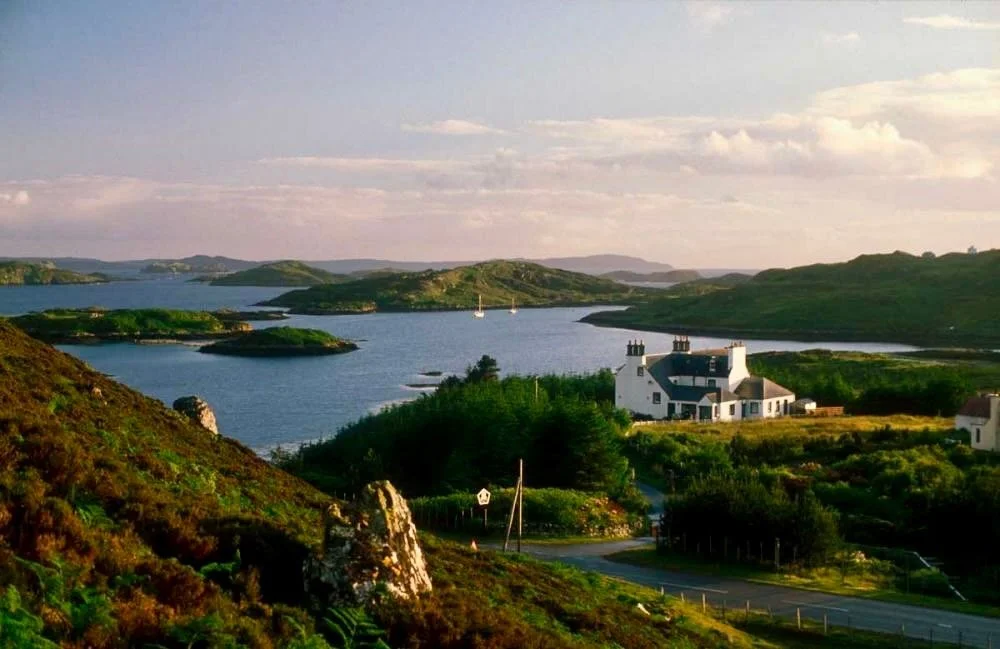
Early days of Eddrachilles as a Hotel
The former manse — the warden’s house, the building the SYHA wanted and the trustees declined to give them — passed, along with the associated former glebe land, through the slow unwinding of the Colonel’s trust and into the ownership of the Wood family. The policies were split several times in subsequent decades until today the former manse is a hotel with 3 acres of woodland grounds leading to the shore and a new build Eddrachillis House has been established by a new owner of about 100 acres of land. It s a premier letting property on AirBnB. The remaining land is in a trust.
The Stewards of Eddrachilles
Every building of any age is not so much owned but rather held in trust by owners who steward it to the next generation. Owners carry the legacy of those who came before, they work to ensure that what is passed to those who come after is “better” than that which was received. This one is no different. The ministers who served this parish from the manse at Badcall, the Colonel who found his retirement and his rest here, the warden who ran seventy yards of flex across the yard and put up a pep notice — each of them kept the building going in the ways available to them.
Among the more recent stewards was Alasdair Wood, who the hotel business that gave the building its present identity. He served this community in other ways too — as chair of the community council among them — and his contribution to what Eddrachilles has became is woven into everything that followed He died earlier this year having moved south to be closer to family in his retirement. His wife, Cathy of whom guests and former staff still speak warmly, died a few years ago. Alasdair and Cathy have an honoured place among the stewards of this building, and leave a legacy that changed its trajectory significantly. Rest at ease, your service is complete.
We are, in our turn, the current keepers of it. The habit of welcome that runs through this building’s history — through the manse years, the hostel years, even the wartime years — is what we are here to continue.
The pep notice has been retired. The flex has been replaced by something rather more permanent. But the walkers, the lovers of nature and of adventures, well, they still come.
Author: Fiona Campbell Trevor, co-owner of Eddrachilles Hotel who writes occasionally about hotel life in the North West Highlands, gardening on the Highland coast and history.
Sources: Scottish Youth Hostel Association archive documents including SYHA minutes 1950–1959, General Secretary Cromar’s inspection report 18th May 1951, building committee reports November 1957, and SYHA annual reports 1950–1959. Occupancy figures from SYHA records. Background on Colonel Thomas Wilkinson Cuthbert CMG DSO from family and regimental sources. Additional context from the parish history of Eddrachillis.